
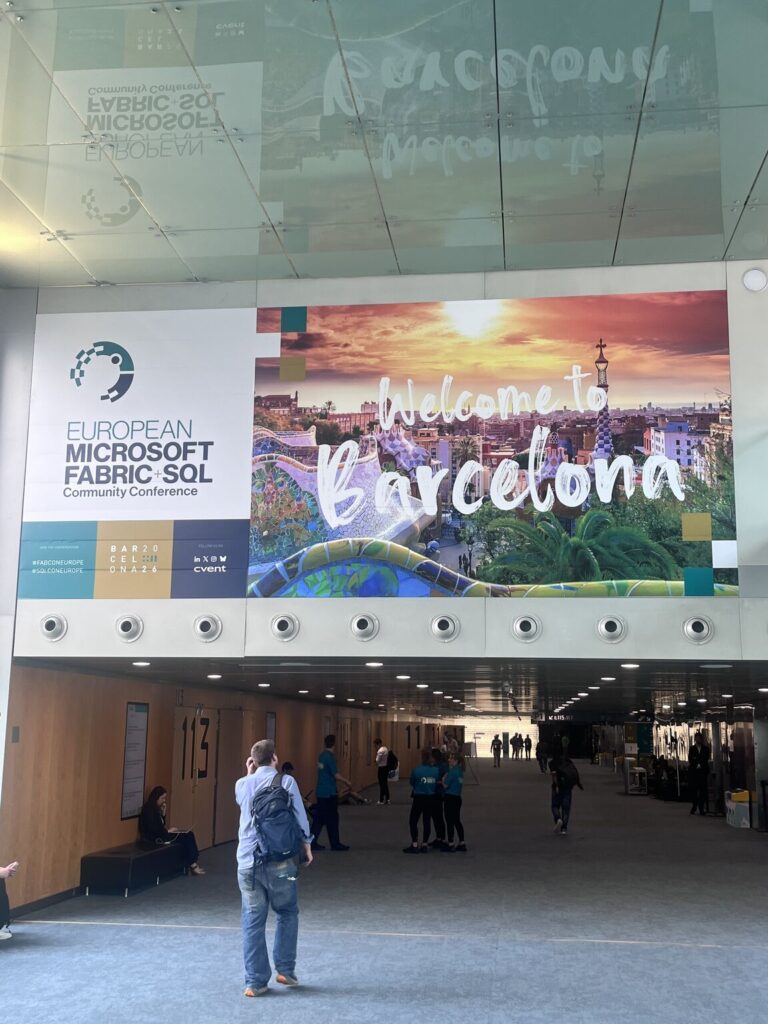
FABCON Europe 2026 brought data professionals, Microsoft product leaders, partners and community experts together in Barcelona to explore the future of data, analytics and AI.
From Microsoft Partner Day to technical sessions covering real-time intelligence, semantic models and AI agents, one theme stood out: the Data + AI ecosystem is becoming increasingly connected, and understanding business context is becoming more important than ever.
Microsoft Partner Day: Customer Value and the Future of Consulting
The week began with Microsoft Partner Day, where the focus extended beyond technology to customer challenges, business outcomes and the evolving role of Microsoft partners.
During Partner Day, we had the opportunity to speak with Arun Ulag, Executive Vice President of Azure Data at Microsoft, about the future of consulting in an increasingly agentic world.
One reflection from the discussions was how AI and automation are changing the way technology solutions are delivered. As implementation becomes more efficient, consultants have an opportunity to contribute more through business understanding, architecture and identifying where technology creates meaningful value.
For data engineers and architects, this reinforces the importance of engaging early in customer conversations. Successful delivery starts before implementation — with understanding the problem, defining the right approach and connecting business and technical perspectives.
From Connected Data to Connected Business Understanding
The conference announcements provided a practical view of where Microsoft’s Data + AI ecosystem is heading.
In his FABCON keynote recap, Arun Ulag highlighted the importance of connecting enterprise data and business context to Microsoft Copilot and AI agents.
One significant development was Fabric IQ becoming generally available in Microsoft Copilot Chat and Cowork, allowing users to ask business questions grounded in trusted Power BI semantic models and reports.
Meanwhile, developments around Fabric IQ Ontology and Semantic Views point towards making business definitions, relationships and metrics reusable across analytics, applications and AI.
Consider a business asking an AI agent why a particular customer order is delayed. Accessing order records is only part of the solution. Understanding how orders relate to customers, inventory, deliveries and business rules is what makes the answer meaningful.
This is where semantic models and ontology become increasingly relevant: connecting data to the business concepts it represents.
Making Data Engineering and Analytics More Accessible
Another interesting direction was the growing role of AI-assisted development.
Project Osmos, with its agentic data engineering capabilities, and developments around Fabric Apps demonstrated how AI is becoming part of building data pipelines, analytics and business applications.
As highlighted in Bogdan Crivat’s FABCON analytics recap, the developments also extend to GPU-accelerated warehouse queries, more open semantic definitions and bringing governed analytics into everyday workflows.
Other announcements, including OneLake IQ Sharing, Fabric observability and improvements to real-time intelligence, reinforced the broader direction of a more integrated ecosystem.
The growing Fabric community, including Microsoft MVPs and independent experts, also brought valuable practical perspectives on adoption, governance and architectural trade-offs.
These innovations can reduce the effort required to build solutions, but they also make good data foundations, governance and architectural decisions even more important.
What Does This Mean for Customers and Consultants?
For organisations, the opportunity goes beyond adopting individual Fabric capabilities. It is about connecting existing data investments, business knowledge and AI to solve real problems.
For consultants, this means looking beyond individual technologies and thinking more holistically about the customer’s data landscape.
Questions such as:
- What business problem are we solving?
- How are business concepts connected?
- Can the same trusted definitions support reporting, applications and AI agents?
become increasingly important.
The role of data professionals is not becoming less technical. Rather, it is expanding towards combining engineering expertise with semantic architecture, business understanding and value strategy.
Looking Ahead
FABCON Europe 2026 offered plenty of new capabilities, but the biggest takeaway was not about any single announcement.
The boundaries between data engineering, analytics, AI and business applications are becoming increasingly blurred. As these building blocks come closer together, organisations have new opportunities to make better use of their data and turn it into meaningful business outcomes.
For us at Etlia, this reinforces the importance of combining strong technical expertise with a deep understanding of our customers’ businesses — helping them navigate evolving technologies, make informed architectural choices and focus on solutions that deliver lasting value.
As technology becomes easier to implement, the real differentiator is knowing what to build, how the data connects and where it creates value. And that starts with understanding the business.
What could this evolving Data + AI landscape mean for your organisation? Whether you’re exploring new opportunities or rethinking your existing data architecture, we’d be happy to exchange ideas and explore what makes sense for your business. Get in touch and let’s explore the possibilities together!
– Raaju Srinivasa Raghavan, Partner & Senior Cloud Consultant / Data Engineer
