
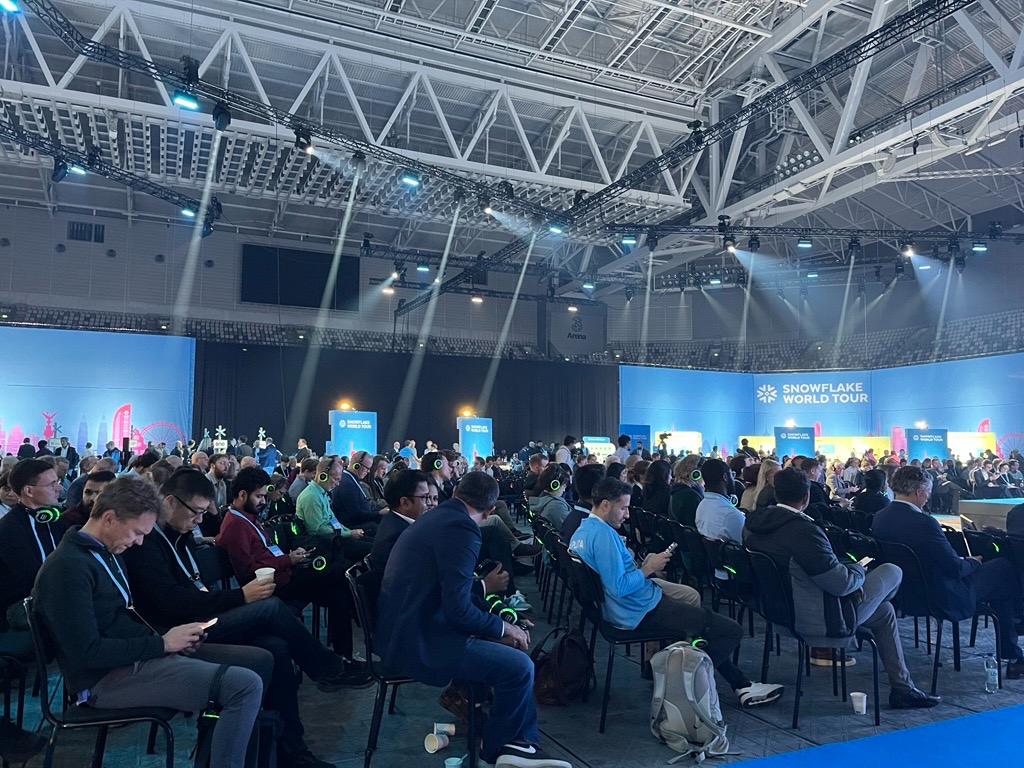
Snowflake World Tour 2026 returned to Stockholm, bringing together more than 2,000 attendees to explore the latest developments in data and AI from Snowflake. The agenda featured more than 30 sessions and 67 speakers representing 11 different industries, covering everything from technical solutions and customer stories to Snowflake’s latest capabilities.
With such a broad agenda, it was easy to build the day around your own interests. My choices focused particularly on Snowflake’s AI capabilities, data governance and cost management, as well as how AI is changing data engineering.
Based on what we saw at the event, the direction is clear: we are moving beyond individual AI features towards agents and the concept of the Agentic Enterprise. AI is no longer limited to answering questions. It can use an organisation’s data, applications and business context to perform tasks.
At the same time, one message came through across almost every topic: the more responsibility we give to AI, the more important trusted data, governance and cost management become.
Snowflake World Tour 2026 Keynote – towards the Agentic Enterprise
The Agentic Enterprise was a central theme in Snowflake’s keynote. However, taking advantage of AI agents requires more than simply adopting a new AI service. Agents need trusted data, business context, governance and integrations with the organisation’s other systems.
Snowflake’s agentic environment is built around three key elements:
- enterprise data and context,
- AI models,
- and software and applications.
These are brought together by an agent management layer designed to connect and manage the overall environment in a controlled way.
Examples highlighted in this context included Snowflake CoWork, which brings AI agents into employees’ daily workflows, and the more developer-focused Snowflake CoCo, which aims to accelerate the development of Snowflake-based software and data solutions with AI assistance.
At the same time, Snowflake emphasised the importance of an organisation’s own data, its business context and a governance model that enables agent activity to be controlled.
Another interesting announcement in the keynote was the collaboration between Snowflake and European cloud provider STACKIT. The collaboration aims to provide European organisations with a local cloud option. STACKIT operates data center in Germany and Austria.
Trusted data is still the foundation
Despite the strong focus on AI, one familiar theme came up repeatedly throughout the day: without high-quality, well-governed data, there can be no trustworthy AI.
Swedbank’s presentation explored the bank’s Data & AI transformation and Snowflake’s role as its technical foundation.
The goal is to move from a situation where data is primarily seen as an IT responsibility towards a model where data is a shared resource across the entire business. Key objectives of the transformation include improving data quality and availability, reducing manual work, and bringing analytics and AI closer to everyday business decision-making.
Perhaps the most important message from the presentation was simple: trusted AI requires trusted data. Building AI solutions does not reduce the importance of a solid data platform, data quality or governance solutions. On the contrary, they become even more important.
More control over Snowflake governance and costs
Snowflake has introduced several new capabilities for cost management and control. Costs can be monitored from the organisational level all the way down to individual users and teams. Budgets can also be defined for specific resources or based on tags.
AI-related costs can now be monitored more closely as well. This will become increasingly important as the use of AI services grows, as models and agents introduce a new cost dimension into the Snowflake environment. Per-user quotas and the ability to automate actions when budget thresholds are reached make these costs easier to manage.
The aim is to give users more freedom to build solutions while allowing the organisation to maintain control over costs.
Semantic Views create a shared meaning for data and AI
As AI adoption grows, the importance of the semantic layer increases. If, for example, revenue is defined differently in Power BI, SQL queries and the context provided to an AI agent, the same question may produce several different answers.
Snowflaken Semantic View aims to address this by centrally defining business concepts, metrics, dimensions and the relationships between them in Snowflake. Semantic Studio makes semantic models easier to build. Previously, these models were largely created using YAML definitions, but they can increasingly be created and maintained visually and with the help of natural language.
Another interesting development is the integration of Snowflake’s semantic layer with other tools that use semantic models. For example, existing Power BI models can be used as a starting point for a Semantic View, while the same definitions can be utilised in Power BI and Excel.
Ultimately, the same business definitions can serve BI reporting, SQL queries, applications and AI agents.
Snowflake CoWork and Cortex Agents take AI from questions to action
Snowflake CoWork was one of the most visible AI topics of the day. Its goal is to act as a personal work tool that understands an organisation’s data and context and can use different tools to perform tasks.
The key shift compared with earlier AI solutions is the move from a question-and-answer model towards action. Instead of simply analysing data and generating answers, an agent can use other agents, tools and enterprise systems to complete tasks.
This development is supported by capabilities such as CoWork automations, user-specific skills and integrations with other tools. In practice, the goal is that users do not need to know which agent or technical component is required for a particular task. Instead, CoWork can route the task to the appropriate agent.
AI is no longer simply a separate feature layered on top of the data platform. It is becoming an integral part of everyday work.
The role of the Data Engineer is changing with AI

Another topic that emerged throughout the day was the changing role of the Data Engineer. With AI, more tasks can be automated, including code generation, routine debugging, creating initial pipeline structures, and code migrations and refactoring.
This does not eliminate the need for Data Engineers. Instead, the focus is shifting towards understanding systems and solutions as a whole, designing data products, governance and understanding the business.
The value of a Data Engineer will therefore not be determined simply by how quickly they can make a pipeline or write SQL. The ability to understand what kind of solution should be built, how data should be governed and how the technical implementation serves the business will become increasingly important.
Snowflake World Tour 2026 – AI is moving from experimentation into the data platform
Snowflake World Tour was once again a valuable opportunity to see where Snowflake and the broader data industry are heading.
The future clearly looks increasingly agentic. At the same time, one of the strongest takeaways from the day was that AI does not reduce the importance of high-quality data, governance or cost management – quite the opposite.
The more opportunities we give AI to use enterprise data and perform tasks independently, the more important it becomes to understand what the data means, who is allowed to use it and at what cost.
-Asko Ovaska
Partner, Senior Data Engineer
