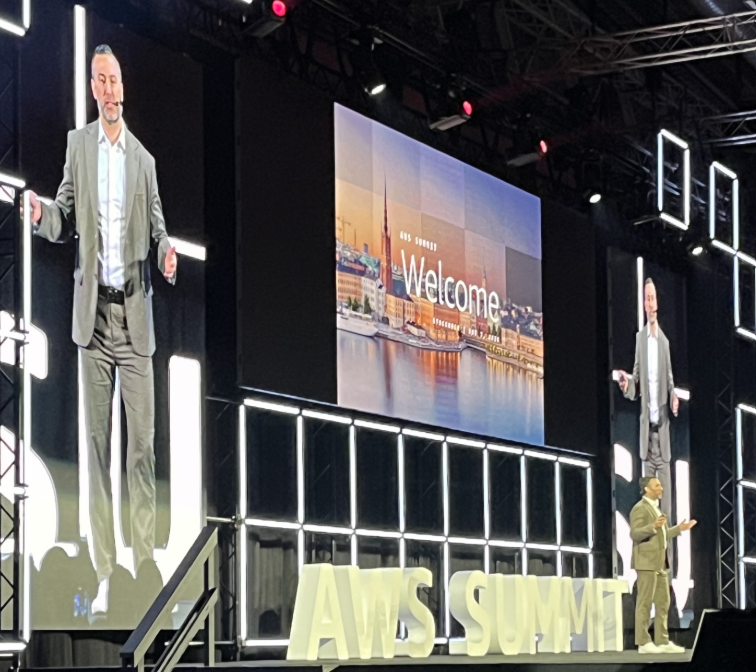
For me, one sure sign that summer is approaching is AWS Summit Stockholm. The event offered a glimpse into where cloud services, data platforms, and AI solutions are heading. This year’s clear themes were agent-based AI, data management through modern data lakes, and AWS’s ambition to make AI a genuine part of business processes — not just isolated technology projects.
The event featured more than 80 sessions across different domains, and this blog highlights key takeaways from the sessions I attended. The sessions focused on agent-based solutions, generative analytics, and modern data lakes.

Agent-Based AI Takes Center Stage
The keynote outlined AWS’s vision that the next phase of AI will be built around intelligent agents. AWS emphasized that organizations are no longer aiming merely to leverage individual AI models, but to build complete intelligent workflows and automation-supporting agents.
Several customer stories illustrated this shift in practice. Danske Bank has migrated its infrastructure to AWS with the goal of modernizing its data and analytics platform while accelerating service development. Meanwhile, Zenseact shared how it has built a data factory on AWS to support autonomous driving development, where massive amounts of data, analytics, and machine learning are combined at scale.
One particularly interesting case was DNB Bank’s KYC (Know Your Customer) solution, where AI is used for customer data verification and risk management. The solution combined Amazon Bedrock, generative AI, and agent-based automation. It was a strong example of how organizations are moving AI beyond isolated experiments toward production-ready business solutions.
Perhaps the keynote’s most important message, however, related to data. AWS repeatedly stressed that without a clear data strategy, it is impossible to build a sustainable AI strategy. This is visible in many organizations today: a large share of IT budgets is still spent maintaining legacy systems, slowing down AI adoption.
From a technology perspective, Amazon Bedrock, new AWS agent solutions, and the continued expansion of Amazon S3 into an increasingly powerful and versatile data layer were particularly prominent.
Amazon Quick and Generative BI
AWS aims to lower the barrier for organizations to utilize data. One approach is Amazon Quick, which brings generative AI into analytics and reporting.
The Amazon Quick session introduced features such as QuickSight, QuickFlows, Quick Automate, and Quick Research. In practice, these enable analytics, automation, and information retrieval using natural language without requiring deep technical expertise.
Within Amazon Quick, chat-based agents and knowledge space solutions are integrated directly into daily business workflows. This trend is visible across the market: analytics is no longer limited to BI teams — the goal is to make data a truly organization-wide tool.
Technologically, the solution relies heavily on generative AI, Amazon Bedrock, and AWS’s analytics ecosystem.
Modern Data Platforms and S3 Tables
From a data perspective, a major theme throughout the event was the construction of modern data platforms around Apache Iceberg and S3 Tables.
The “Modern Batch Analytics” session demonstrated how AWS is building next-generation analytics solutions by combining Amazon S3 Tables, Apache Iceberg, AWS Glue, Lake Formation, and Athena. The goal is to enable scalable and transactional data lakes without the limitations of traditional data warehouse solutions.
The session also highlighted data governance and security. Lake Formation’s role in access management and Glue orchestration were key parts of the overall architecture.
SageMaker Unified Studio and QuickSuite are also bringing analytics, machine learning, and visualization closer together on a single platform. AWS’s strategy appears to focus on building a unified data ecosystem where data engineering, analytics, and AI integrate seamlessly.
Case Funnel: Agent-Based Data Integrations
One of the most practical sessions was Funnel’s presentation on agent-based data integrations.
Funnel addressed a familiar challenge for data organizations: SaaS APIs constantly change, integrations are fragile, and maintaining them consumes significant time and effort.
As a solution, Funnel has built a declarative connector platform that is now being extended with agent-based AI. The idea is that AI agents can automatically interpret APIs, build data models, and transform raw data into analytics-ready formats.
This was one of the clearest examples of how generative AI can be applied in data engineering on a practical level. At the same time, it reflected the broader transformation taking place across the industry: manual integration work is increasingly being automated.
Funnel’s Open Data Lake solution built on AWS also demonstrated the growing importance of open formats and data lake architectures.
Apache Iceberg and Modern Data Lakes
The final session focused on Apache Iceberg and building modern data lakes on top of Amazon S3.
Apache Iceberg emerged during the event almost as a standard for modern data platforms. The technology offers transactional capabilities, schema evolution, and improved performance for large-scale data lakes.
The session particularly covered operational best practices, including metadata optimization, schema design, and cost management.
AWS strongly emphasized its S3 Tables solution, which aims to simplify the management of Iceberg-based data lakes. AWS clearly sees data lakehouse architectures as a central part of future analytics and AI solutions.
An important observation was that data lake development is no longer focused solely on storage. The goal now is to build platforms that simultaneously support analytics, machine learning, generative AI, and agent-based applications.
Summary
AWS Summit Stockholm 2026 reinforced the understanding that AI is moving from experimentation toward production use — although there is still a journey ahead. Agent-based solutions, generative analytics, and modern data lakes are advancing rapidly.
At the same time, the event served as a reminder that a successful AI strategy is still built on top of a strong data foundation. Organizations need to modernize their data architectures, automate integrations, and manage data effectively before they can fully realize the business value of AI.
AWS’s strong investments in Amazon Bedrock, Apache Iceberg, S3 Tables, and agent-based solutions provide a clear indication of where the cloud and data ecosystem is heading in the coming years.
-Asko Ovaska, Partner, Senior Data Architecht & Engineer